
Courtesy of the United States Air Force
LIEUTENANT GENERAL FRANK ALTON ARMSTRONG JR.
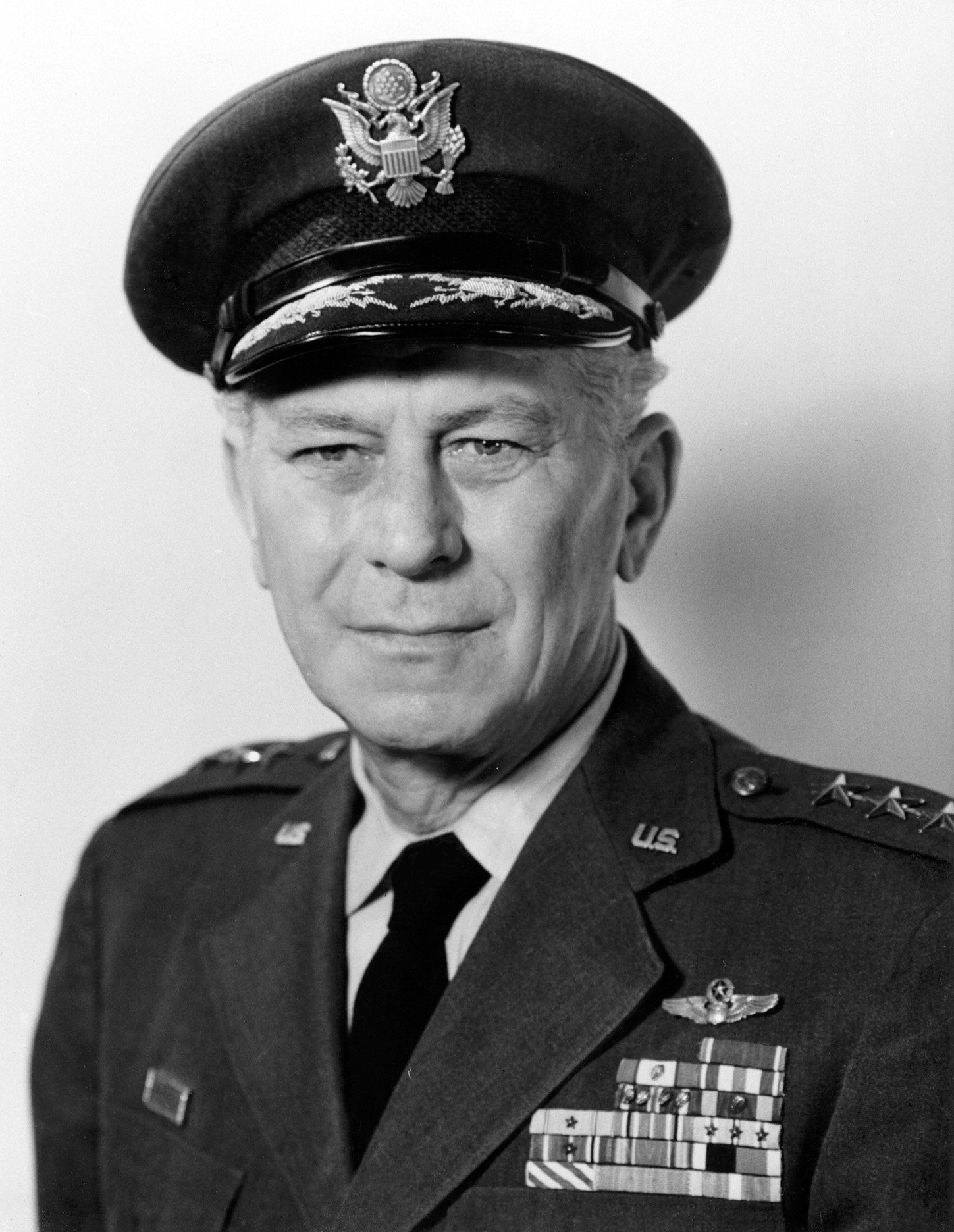
Retired August 1, 1962. Died September 1, 1969.
Frank Alton Armstrong Jr., was born at Hamilton, N.C., in 1902. He graduated from Wake Forest College in 1923 with a bachelor of laws degree. Two years later he received a bachelor of science degree from Wake Forest.
He began military service in February 1928 when he enlisted as a flying cadet at Nashville, North Carolina. He received primary training at Brooks Field, Texas and advanced training at Kelly Field, Texas. He received his pilot’s wings in March 1929 and today is a command pilot with around 11,000 flying hours. He has flown the B-47 Stratojet in addition to many types of conventional aircraft.
Lieutenant Armstrong’s first assignment after Kelly Field was with the Second Bombardment Group at Langley Field, Virginia. The lieutenant returned to Kelly Field in 1930 to attend the Flying Instructors’ School and then went to March Field, Calif., as a flying instructor. In 1931 he transferred to Randolph Field, Texas where he continued his flying instruction duties.
In 1934, Lieutenant Armstrong received special navigation and instrument flying training at Rockwell Field, California, before he became a chief pilot with the Air Corps mail operations at Salt Lake City, Utah.
His first overseas tour was with the 78th Pursuit Squadron at Albrook Field, Canal Zone. Other pre-World War II assignments were: commander of the 13th Bombardment Squadron at Barksdale Field, La; a student at the Air Corps Tactical School at Maxwell Field, Alabama a military observer in England; with the 90th Bombardment Squadron at Savannah, Georgia, Air Base; and duty at Air Force Headquarters in Washington, D.C.
Early in 1942, Lieutenant Colonel Armstrong went to England to become the operations officer for the Eighth Bomber Command. After promotion to colonel during the same year, he became a bombardment group commander and a wing commander.
Colonel Armstrong led the first daylight raid ever made by the U.S. Army Air Force over Axis territory. This raid over Rouen-Sotteville, France blasted the target without loss of life or aircraft. For this operation Colonel Armstrong received the Silver Star and an oak leaf cluster to the Distinguished Flying Cross. (He had received the Distinguished Flying Cross in 1936 for the landing of a twin-engine amphibian after one engine had exploded). He was also awarded the British Flying Cross for the Rouen-Sotteville raid, the first United States officer to be so honored.
Early in 1943, Brigadier General Armstrong led the group over Wilhelmshaven in the first heavy bomber raid over Germany proper. The B-17 experiences during this time became the basis of Bierne Lay Jr. and Sy Bartlett’s book and movie “Twelve O’Clock High”.
He returned to the United States in August 1943 and commanded bombardment training wings at Dalhart, Texas, Ardmore, Okla., and Colorado Springs, Colo. He then headed the 315th Bomb Wing at Peterson Field, Colo.
Brigadier General Armstrong’s stay in the United States was of short duration. By mid-year 1945 he went to the Pacific where he took command of the same bomb wing that he trained at Peterson Field.
During the summer of 1945 he flew numerous missions over oil targets in Japan. In August he flew from Guam to Honshu, the longest and last very heavy bombing raid in the war, without bomb-bay tanks and with an extremely heavy bomb load. In November 1945, he led the first non-stop flight from Hokkaido, Japan, to Washington, D.C., in a Boeing B-29 bomber. He was awarded an oak leaf cluster to the Distinguished Flying Cross for each of the above achievements.
With World War II ended, Brigadier General Armstrong could look back on many significant achievements he had made during this worldwide conflict. He had served in both theaters. He personally led the first and last heavy bombing raids of World War II.
Early in 1946, he became the Pacific Air Command chief of staff for operations and later that year he returned to the United States to become senior air instructor at the Armed Forces Staff College at Norfolk, Va.
Early in 1949, Brigadier General Armstrong began the first of two tours in Alaska. He headed the Alaskan Air Command. In addition to increasing the combat capabilities of the Air Forces in Alaska, he pioneered (with other members of the Alaskan Air Command) an air route non-stop from Alaska to Norway, and from Norway to New York. Following the flight to Norway, he received the Gold Medal of the Aero Club of Norway, the highest civil award of that country.
Early in 1950, Armstrong was promoted to major general and a year later returned to the United States to command Sampson Air Force Base, New York. He was commended for the harmonious relationship established between the base and surrounding civil communities in the trying period of base activation.
Later in 1951, Major General Armstrong became commanding general of the Sixth Air Division at MacDill Air Force Base, Florida, trained and equipped the Air Force’s first B-47 Stratojet Wing.
The general in late 1952 commanded Strategic Air Command’s Second Air Force at Barksdale Air Force Base, Louisiana. He held this position for almost four years.
In July 1956, Major General Armstrong returned to Alaska to again head the Alaskan Air Command. Two months later, he became commander in chief, Alaska, was promoted to lieutenant general and now heads the unified Alaskan Command with headquarters at Elmendorf Air Force Base.
EDUCATION
1923 Wake Forest College, N.C., with an bachelor of laws degree
1925 Wake Forest College, N.C., with a bachelor of science
1928 Primary Flight Training, Brooks Field
1929 Advanced Flight School, Kelly Field
1930 Flying Instructors’ School, Kelly Field
1939 Air Corps Tactical School, Maxwell, Field
1947 Armed Forces Staff College
ASSIGNMENTS
1. Feb. 1928 – March 1929 Flying School at Brooks and Kelly fields, Texas
2. March 1929 – Jan. 1930 member of Second Bomb Group, Langley Field, Va.
3. Jan. 1930 – Feb. 1931 student at Flying Instructors’ School, Kelly Field, Texas
4. Feb. 1931 – Dec. 1931 flying instructor, March Field, Calif.
5. Dec. 1931 – Jan. 1934 flying instructor, Randolph Field, Texas
6. Jan. 1934 – Dec. 1934 chief pilot of the Air Corps mail operations at Salt Lake City, Utah
7. Dec. 1934 – March 1937 pilot in pursuit and observation squadrons, Albrook Field, Canal Zone
8. March 1937 – Nov. 1939 member of 13th Bomb Squadron, Barksdale Field, La.
9. Nov. 1939 – Nov. 1940 commander of 13th Bomb Squadron, Barksdale Field, La.
10. Nov. 1940 – Feb. 1941 military observer in England
11. Feb. 1941 – April 1941 member of 90th Bomb Squadron, Savannah Air Base, Ga.
12. April 1941 – Aug. 1941 member of the 3rd Interceptor Command, Tampa, Fla.
13. Aug. 1941 – Feb. 1942 staff duty at Air Force Headquarters Washington, D.C.
14. Feb. 1942 – Aug. 1943 bomb group, wing and division commander in European Theater of Operations
15. Aug. 1943 – Nov. 1944 commander of bomber training wings at Dalhart, Texas, Ardmore, Okla., and Colorado Springs, Colo.
16. Nov. 1944 – May 1945 commander of 315th Bomb Wing, Peterson Field, Colo.
17. May 1945 – Sept. 1946 commander of 315th Bomb Wing in Pacific Area
18. Sept. 1946 – June 1948 senior air advisor Air Force Staff College, Norfolk, Va.
19. June 1948 – July 1950 deputy commanding general Alaskan Air Command
20. July 1950 – Jan. 1951 commanding general Alaskan Air Command
21. Jan. 1951 – May 1951 commanding general Sampson Air Force Base, N.Y.
22. May 1951 – Oct. 1952 commanding general Sixth Air Division, MacDill Air Force Base, Fla.
23. Oct. 1952 – July 1956 commanding general Second Air Force, Barksdale, Air Force Base, La.
24. July 1956 – Sept. 1956 commander Alaskan Air Command
25. Sept. 1956 – present commander in chief, Alaska
DECORATIONS AND MEDALS
Distinguished Service Cross
Silver Star
Distinguished Flying Cross British
Distinguished Service Medal
Air Medal with oak leaf cluster
Distinguished Flying Cross with four oak leaf clusters
Distinguished Service Medal with oak leaf cluster
Belgian Croix de Guerre with palm
Occupation Ribbon – Japan
Asiatic-Pacific Campaign Medal
European-African-Middle Eastern Campaign Medal with star
American Defense Medal (FSO)
World War II Victory Medal
Philippine Independence Ribbon
National Defense Service Medal
Norwegian Gold Medal
UNUSUAL EXPERIENCES
General Armstrong personally led first and last heavy bomber raids of World War II. The first raid was over Rouen-Sotteville, France. The last raid was over Honshu, Japan. He also led his group over Wilhelmshaven in the first heavy bomber raid over Germany proper. His mission in the Pacific was “destroy ten different oil refineries,” a mission he carried out effectively.
In 1936 while a captain stationed at Albrook Field, Canal Zone, General Armstrong was piloting a Douglas amphibian (OA-4A). During the flight an engine exploded, but by skillful handling he landed the aircraft safely on a small strip located on the Mala peninsula.
The citation for his Distinguished Service Cross reads as follows:
The President of the United States takes pleasure in presenting the Distinguished Service Cross to Frank A. Armstrong Jr., Brigadier General (Air Corps), U.S. Army Air Forces, for extraordinary heroism in connection with military operations against an armed enemy while serving as Commander, 97th Bombardment Group (H), 8th Air Force, while leading his Group in a bombing mission on April 5, 1943, against enemy ground targets in Europe. Brigadier General Armstrong’s gallant leadership and unquestionable valor in aerial combat have upheld the highest traditions of the military service and reflect great credit upon himself, the 8th Air Force, and the U.S. Army Air Forces.
Headquarters: European Theater of Operations. U S Army, General Order No. 53 (1943)
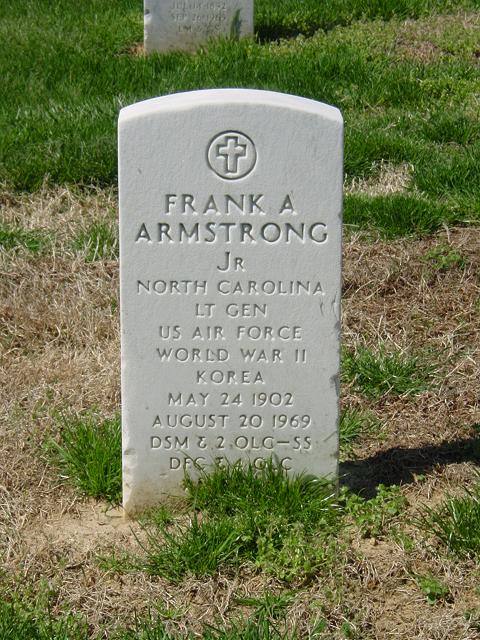
ARMSTRONG, FRANK A
LTG USAF
- VETERAN SERVICE DATES: Unknown
- DATE OF BIRTH: 05/24/1902
- DATE OF DEATH: 08/20/1969
- DATE OF INTERMENT: 08/25/1969
- BURIED AT: SECTION 34 SITE 13-A
ARLINGTON NATIONAL CEMETERY

Michael Robert Patterson was born in Arlington and is the son of a former officer of the US Army. So it was no wonder that sooner or later his interests drew him to American history and especially to American military history. Many of his articles can be found on renowned portals like the New York Times, Washingtonpost or Wikipedia.
Reviewed by: Michael Howard